The massive white sphere of Avicii Arena, still called “the Globe” by most Stockholmers, serves an unusual second purpose: it represents the Sun in the world’s largest permanent scale model of the solar system.
The Sweden Solar System (SSS) stretches across the country at a scale of 1:20,000,000, where each meter you walk equals 20,000 km of actual space. Several planets sit within Stockholm’s city limits, from Mercury near Slussen to Jupiter at Arlanda Airport, while the outer planets extend north across Sweden, Neptune sits 300 km away in Söderhamn.
If you like the idea of turning a normal day of sightseeing into a small mission, this could be a fun adventure: The inner planets (Mercury, Venus, Earth, and Mars) cluster in the northern and central parts of the city, while Jupiter waits at the airport. Each location has a scale model and informational panels explaining the planet’s characteristics.
Whether you track down all the Stockholm planets or simply notice one while visiting the Natural History Museum, become a fun project that turns ordinary distances into cosmic perspective.
The Sun (Avicii Arena / “the Globe”)
Avicii Arena represents the Sun, and it’s the starting point for the whole model.
Where: Globentorget 2 (Globen area)
Getting there: Take the subway to Globen or Gullmarsplan, then walk a few minutes. If you’re doing SkyView, there’s also an info sign connected to the project near that entrance.
Mercury (Stockholm City Museum)
A small Mercury sphere outside/at the Stockholm City Museum (Stockholms stadsmuseum), about 2.9 km (1.8 miles) from the Globe in the project’s scale-walk.
Where: Ryssgården, Slussen.
Getting there: Take the subway to Slussen, then walk to the City Museum entrance.
Venus (House of Science at AlbaNova)
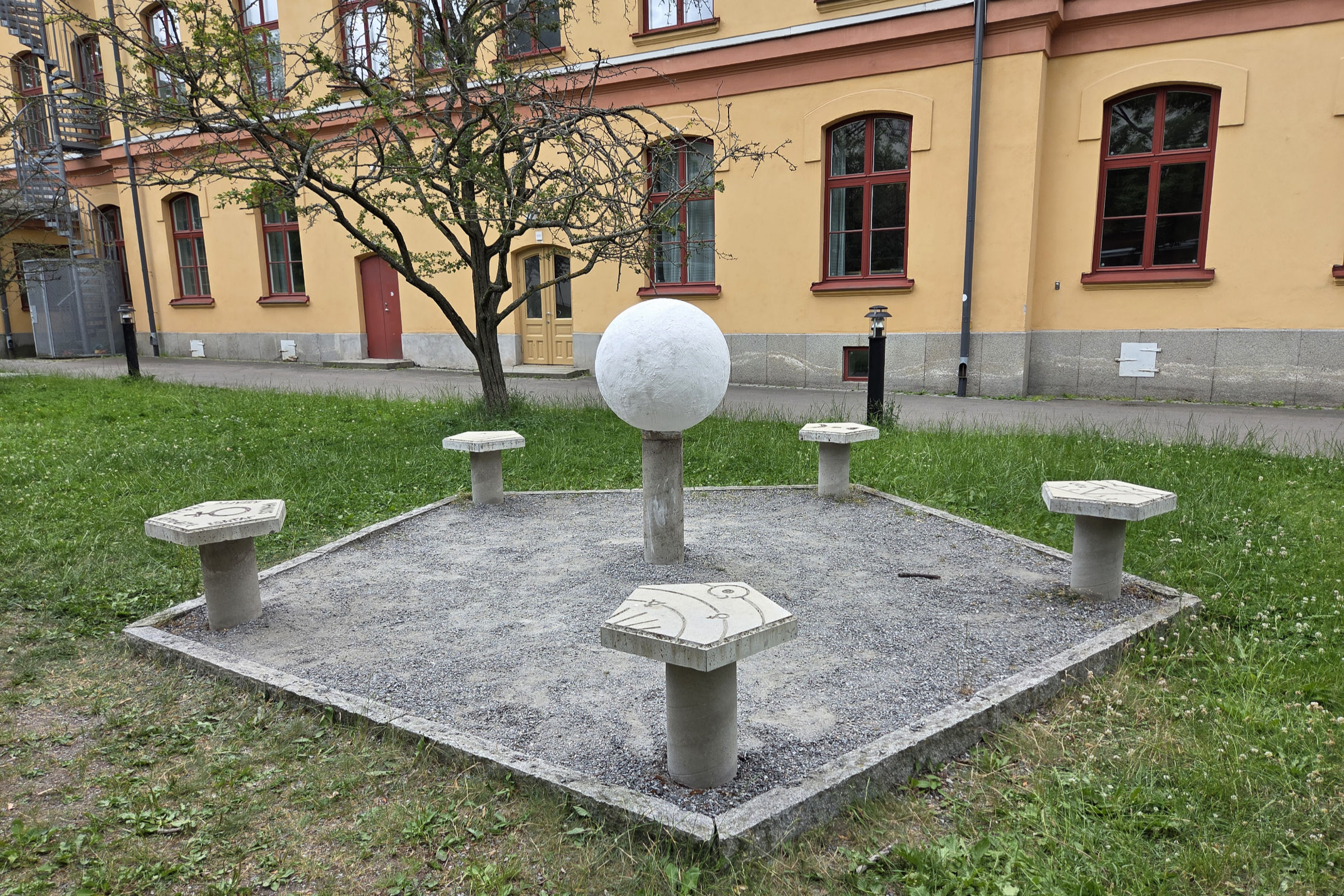
Venus sits outside Vetenskapens Hus (House of Science) at AlbaNova universitetscentrum. It’s a mosaic-covered model with panels that explain Venus (phases, greenhouse effect, and more).
Where: Roslagstullsbacken 29
Distance in the model: 5.5 km (3.4 miles) from the Globe.
Getting there: Take the subway to Tekniska högskolan or Universitetet, then walk toward AlbaNova/Vetenskapens Hus. (It’s in the university area just north of the city.)
Earth (and the Moon) at the Natural History Museum
Earth (and the Moon nearby) are at the Swedish Museum of Natural History (Naturhistoriska riksmuseet), close to the Cosmonova entrance.
Distance in the model: 7.6 km (4.7 miles) from the Globe.
Where: Frescativägen 40
Getting there: Take the subway to Universitetet, then follow signs to Cosmonova / Naturhistoriska riksmuseet (about a 5–10 minute walk).
Mars (Mörby Centrum)
Mars is placed inside Mörby Centrum (Danderyd), and it’s designed with details that hint at Mars exploration.
Distance in the model: 11.6 km (7.2 miles) from the Globe.
Where: Golfvägen 6
Getting there: Take the subway to Mörby Centrum, then enter the shopping center.
Jupiter (Arlanda Airport)
Jupiter is represented by a 7.1 m (23.3 ft) glowing ring at Clarion Hotel Arlanda, connected to Sky City. It also includes the four Galilean moons along the corridor leading toward the hotel.
Distance in the model: 40 km (about 25 miles) from the Globe.
Where: 190 60 Stockholm-Arlanda
Getting there: Go to Arlanda Airport (Sky City), then follow the corridor toward Clarion Hotel Arlanda (the moons are along the way).
Visiting the Sweden Solar System
The inner planets make a manageable mission if you’re spending several days in Stockholm. Mercury and Earth are near attractions you might visit anyway, while Venus and Mars require more deliberate detours. Jupiter at Arlanda works best if you’re already heading to or from the airport with time to spare.
The full Sweden Solar System extends all the way to Neptune in Söderhamn, about 300 km north of Stockholm. Most visitors stick to the Stockholm-area planets, which gives you a sense of the scale without turning it into a multi-day road trip.
This isn’t a conventional tourist activity, and that’s the point. You’re following a scientific concept through the city rather than a curated sightseeing route. The planet models are modest, informational spheres and installations, but walking distances that represent millions of kilometers adds an unexpected dimension to simply getting around.