The Sweden Solar System is the world’s largest permanent scale model of the solar system, and six of its stops are in and around Stockholm. Avicii Arena, the white dome Stockholmers still call the Globe (Globen), is the Sun. Mercury, Venus, Earth and Mars are within 12 km (7 miles) of it, and Jupiter is at Arlanda Airport.
The model is built at a scale of 1:20,000,000, so each meter equals 20,000 km of space. At every stop you’ll find a model of the planet and a sign with facts about it. North of Stockholm the model continues through Uppsala, where a new Saturn was unveiled on October 22, 2026, and stretches as far as Kiruna.
Below is every planet in the Stockholm area, with where to find it and directions from T-Centralen, followed by tips for fitting the stops into a day of sightseeing.
| Planet | Where | Distance from the Globe | Nearest station |
|---|---|---|---|
| Sun | Avicii Arena, Globentorget 2 | Starting point | Globen (green line) |
| Mercury | Stockholm City Museum, Ryssgården, Slussen | 2.9 km (2 miles) | Slussen (red or green line) |
| Venus | Vetenskapens Hus, AlbaNova, Roslagstullsbacken 29 | 5.5 km (3 miles) | Tekniska högskolan (red line) |
| Earth and the Moon | Swedish Museum of Natural History, Frescativägen 40 | 7.6 km (5 miles) | Universitetet (red line) |
| Mars | Mörby Centrum, Danderyd | 11.6 km (7 miles) | Mörby centrum (red line) |
| Jupiter | Clarion Hotel Arlanda, by Sky City | 40 km (25 miles) | Arlanda (Arlanda Express or commuter train) |
| Saturn | Campus Polacksbacken, Uppsala | About 70 km (43 miles) | Uppsala C (train from Stockholm Central) |
The Sun (Avicii Arena)
Avicii Arena represents the Sun and is the starting point for the whole model. At 110 m (361 feet) across, it is by far the largest object in the model.
Where: Globentorget 2 (Globen area)
Getting there: From T-Centralen, take the green line toward Hagsätra to Globen, then walk about 5 minutes to the arena. If you ride SkyView, look for the project’s information sign near its entrance.
Mercury (Stockholm City Museum)
A small model of Mercury, 25 cm (10 inches) across, stands outside the Stockholm City Museum on Ryssgården, by Slussen.
Distance in the model: 2.9 km (2 miles) from the Globe.
Address: RyssgårdenSee on map
Getting there: From T-Centralen, take the red or green line two stops to Slussen, then walk about 5 minutes to the City Museum entrance.
Venus (House of Science at AlbaNova)
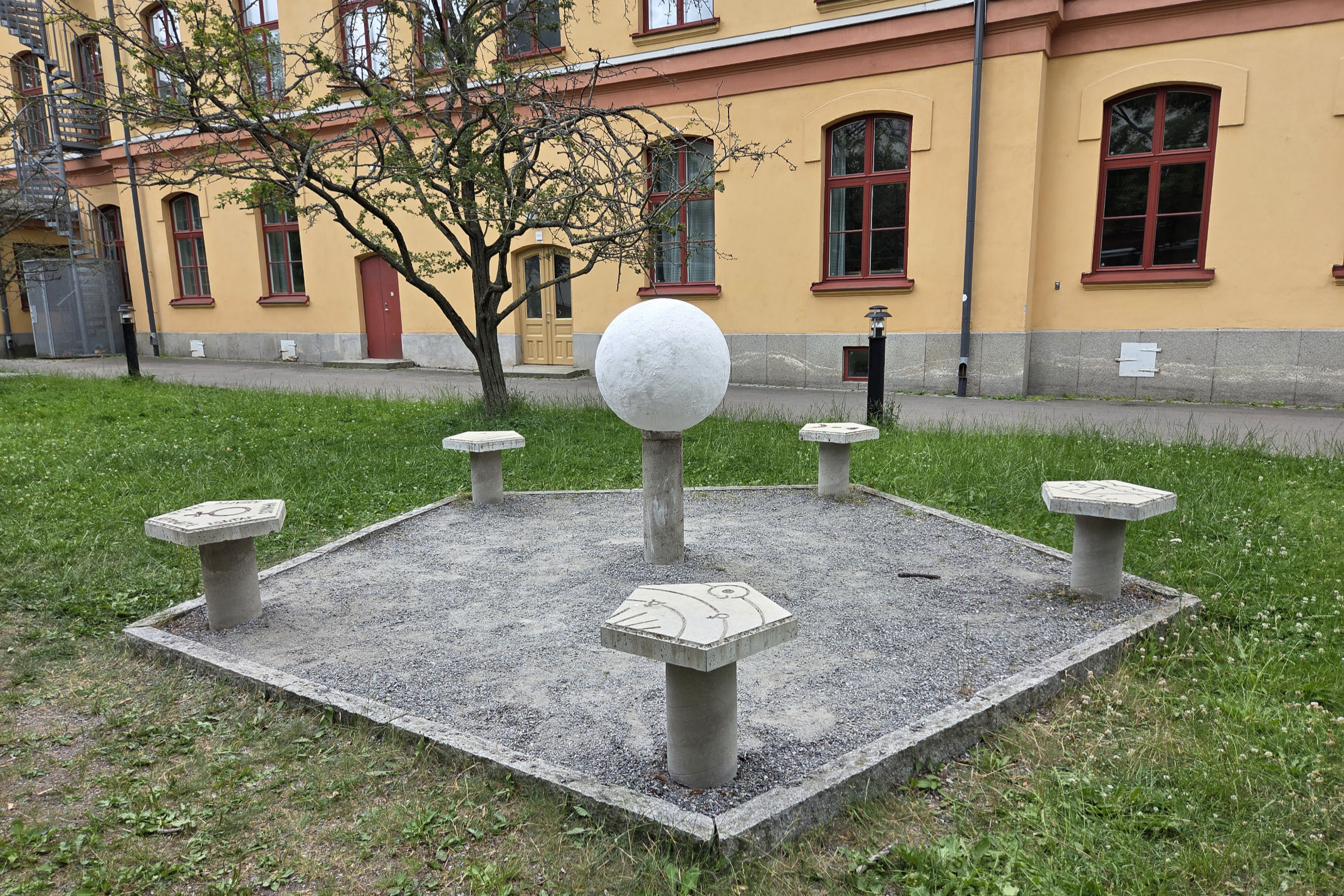
Venus sits outside Vetenskapens Hus (House of Science) at AlbaNova University Center. It’s a mosaic-covered model with panels that explain the planet’s phases and greenhouse effect.
Where: Roslagstullsbacken 29
Distance in the model: 5.5 km (3 miles) from the Globe.
Getting there: From T-Centralen, take the red line toward Mörby centrum to Tekniska högskolan, then walk about 15 minutes north through the KTH campus to AlbaNova.
Earth and the Moon (Swedish Museum of Natural History)
Earth, with the Moon nearby, is at the Swedish Museum of Natural History, close to the entrance to Cosmonova, the museum’s dome theater.
Distance in the model: 7.6 km (5 miles) from the Globe.
Where: Frescativägen 40
Getting there: From T-Centralen, take the red line toward Mörby centrum to Universitetet, then walk 5–10 minutes, following the signs to the museum and Cosmonova.
Mars (Mörby Centrum)
Mars is inside Mörby Centrum, a shopping center in Danderyd just north of Stockholm. The model is designed with details that hint at Mars exploration.
Distance in the model: 11.6 km (7 miles) from the Globe.
Where: Golfvägen 6
Getting there: From T-Centralen, take the red line toward Mörby centrum to the end station, Mörby centrum, then walk into the shopping center.
Jupiter (Arlanda Airport)
Jupiter is a 7 m (23 feet) glowing ring over the entrance to the conference center at Clarion Hotel Arlanda, which is connected to Sky City. The four Galilean moons are shown along the corridor leading to the hotel.
Distance in the model: 40 km (25 miles) from the Globe.
Where: 190 60 Stockholm-Arlanda
Getting there: From T-Centralen, walk through to Stockholm Central for the Arlanda Express, or take the commuter train toward Uppsala from Stockholm City. Get off at Arlanda, walk to Sky City, between Terminals 4 and 5, and follow the corridor toward Clarion Hotel Arlanda.
Beyond Stockholm: Saturn and the outer planets
Past Jupiter, the planets are spread across eastern and northern Sweden, so seeing them takes a road trip rather than a metro ride.
- Saturn: a new model was unveiled on October 22, 2026, at Campus Polacksbacken in Uppsala, by NTI Gymnasiet, and is lit with LED lights after dark. Uppsala is a day trip by train from Stockholm Central.
- Uranus: at Stora magasinet in Lövstabruk, in northern Uppland.
- Neptune: by the river in Söderhamn.
- Pluto: in Delsbo, about 300 km (186 miles) from the Globe.
- The edge of the solar system: the termination shock is marked at the Swedish Institute of Space Physics in Kiruna.
Visiting the Sweden Solar System
The inner planets make a manageable mission if you’re spending several days in Stockholm. Mercury and Earth are near attractions you might visit anyway, while Venus and Mars require more deliberate detours. Jupiter at Arlanda works best if you’re already heading to or from the airport with time to spare.
The full model stretches as far as Kiruna in the far north. Most visitors stick to the Stockholm-area planets, which give you a sense of the scale without a multi-day road trip.
This isn’t a conventional tourist activity, and that’s the point. You’re following a scientific concept through the city rather than a curated sightseeing route. The planet models are modest, informational spheres and installations, but walking distances that represent millions of kilometers adds an unexpected dimension to simply getting around.
Frequently asked questions
In Uppsala. A new model of Saturn was unveiled at Campus Polacksbacken on October 22, 2026, about 70 km (43 miles) from the Globe.
The Sun (Avicii Arena), Mercury (Stockholm City Museum), Venus (AlbaNova), Earth and the Moon (Swedish Museum of Natural History) and Mars (Mörby Centrum). Jupiter is just outside the city, at Arlanda Airport.
Outside Vetenskapens Hus at AlbaNova, Roslagstullsbacken 29, 5.5 km (3 miles) from the Globe. Take the red line to Tekniska högskolan and walk north through the KTH campus.
No. The models in Stockholm are outdoors or in public spaces such as a shopping center and a hotel, so you can see them for free. Earth and the Moon are at the Swedish Museum of Natural History, which is free to enter.
Yes. Mercury, Venus, Earth and Mars are all on or near the red line, so together with the Sun at Globen you can see five stops in about half a day. Add Jupiter if you’re flying from Arlanda.